How to Run a Planning Poker Session with a Remote Team
A complete, practical playbook for facilitating distributed planning poker. Covers preparation, facilitation, follow-up, and what to do when the unexpected happens — from bad internet to a dominant senior voice to teammates joining from three continents.
Before the session: preparation
The single largest determinant of session quality is how well the backlog is prepared. Planning poker surfaces estimation disagreements quickly, but it cannot rescue a story that nobody understands. If you are routinely spending most of the session clarifying what a story means, the issue is refinement, not facilitation.
Groom the backlog first
Each story entering the session should have a clear title, a user-facing outcome, rough acceptance criteria, and any dependencies or known constraints called out. A good heuristic: if a new engineer on the team could not describe what "done" looks like in one sentence after reading the story, it needs more refinement before the vote. Our backlog refinement guide has the fuller treatment.
Decide sync or async
For a team spanning more than about six hours of time-zone difference, async voting with a short sync-up call for outliers is usually more humane than forcing everyone into a single overlap hour. For co-located or near-overlap teams, a 45-minute sync call covers 8 to 12 stories comfortably. Decide this before sending the invite — switching mid-session wastes time.
Send the room URL with an agenda
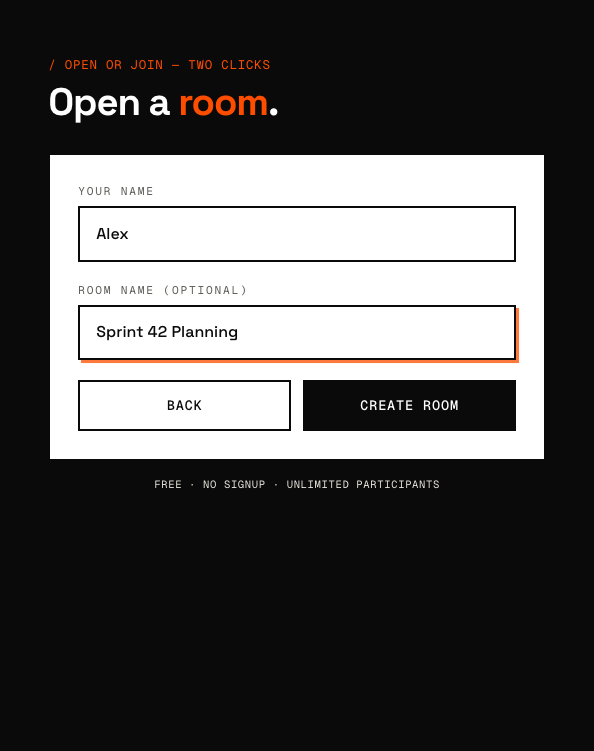
Create the room from the planning poker tool and share the URL in the calendar invite along with a short agenda: stories to cover, sprint goal (if known), and whether the session is sync or async. Distributed teammates who cannot attend live benefit enormously from knowing ahead of time whether they need to block the hour or can vote on their own schedule.
Nominate a facilitator who is not the product owner
The product owner presents stories; the facilitator runs the meeting. Splitting these roles matters because the product owner has an implicit preference about estimates — they want stories to be small enough to fit in the sprint. The facilitator protects the team's honest estimates from that subtle pressure. On most teams, the scrum master or a rotating facilitator does this well.
During the session: facilitation
Open with context, not a story
Spend the first two minutes on the sprint goal and any contextual changes (staffing, production incidents, upcoming launches) that might affect capacity. Remote teammates who have been heads-down on other work benefit from a quick re-orient before diving into story-by-story estimation.
Present one story at a time
The product owner reads the story title, the expected outcome, and key acceptance criteria. Keep this under 90 seconds per story. If presentation takes longer, the story needs more refinement. Open the floor for clarifying questions — these are neutral information requests, not opinions.
Vote privately, reveal simultaneously
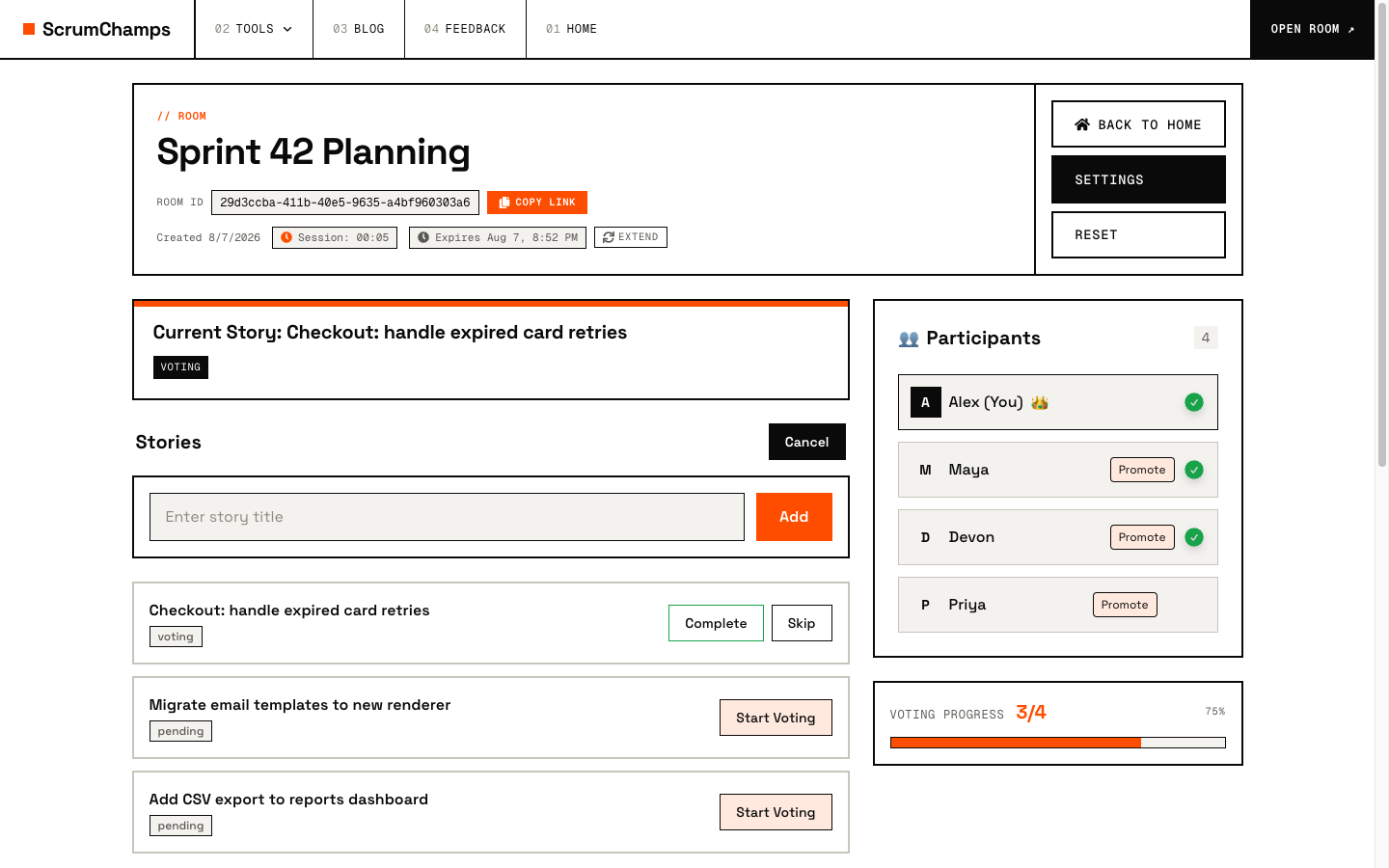
This is the core mechanic and the reason planning poker works. Each teammate selects a Fibonacci card without seeing others' picks. When the whole room has voted, the facilitator reveals. The whole point is to prevent anchoring — if the senior engineer's vote is visible first, the rest of the team will unconsciously cluster around it.
Discuss outliers
When votes span more than two Fibonacci steps (say, a 3 next to a 13), that is where real information lives. Give the high and low voters 60 seconds each to explain their reasoning. Often the high voter has spotted a risk the team missed; occasionally the low voter knows a shortcut. Either way, the team is better informed after the discussion than before.
Re-vote when useful, not always
After discussion, the facilitator asks whether anyone wants to change their estimate. If the spread narrows — a 3 and a 13 become a 5 and an 8 — take the higher of the two as the estimate and move on. If the team is stuck after two votes, the story is almost certainly too big or not well enough understood to estimate. Flag it for splitting and move to the next story.
Keep the pace
Target three minutes per story. Running long is the most common failure mode of distributed sessions — one story that stretches to fifteen minutes kills momentum and tires out teammates in inconvenient time zones. If a conversation is not converging, park the story for refinement and keep moving.
After the session: follow-up
A planning poker room is a live voting surface, not a long-term store of estimates. The last ten minutes of work matter as much as the session itself.
Transfer the numbers. Copy each agreed estimate into Jira, Linear, or whichever tool your team uses for the actual backlog. Do this immediately — the room URL is disposable and you do not want to be looking for it three days later.
Flag split candidates. Any story that came back as a 13, 20, or bigger should be tagged for splitting before the next sprint. Put a ticket in your refinement queue for it rather than letting it slip back into the general backlog.
Share with absentees. If teammates could not attend, post a short summary in your team channel: which stories were estimated, which need splitting, and any significant discussion points. Remote teams that consistently do this build far better shared understanding than teams that assume everyone was in the room.
Troubleshooting distributed sessions
Someone drops off the call mid-vote
Remote networks are unreliable. When a teammate disconnects, wait up to one minute for them to rejoin — rooms persist, so they can reopen the URL without losing state. If they do not rejoin in that window, reveal the vote without them and flag the story for re-estimation at the next sync. Do not hold the whole team for a single disconnect.
One voice dominates the discussion
If the same person always explains their high (or low) vote first, it anchors the re-vote. The facilitator should explicitly call on quieter teammates: "Before we discuss, I want to hear from anyone who has not spoken yet." In persistent cases, rotate the facilitation role — when the dominant voice is the facilitator, someone else takes over next session.
Time zones split the team
For teams spanning more than eight hours of difference, stop trying to do synchronous planning poker. Run the session async: open the room, post an agenda, let teammates vote as they come online, then hold a 15-minute video call only for stories where the spread was wide. This preserves the benefit of private simultaneous voting while respecting everyone's working hours.
The team always converges too quickly
If every vote is immediately unanimous, one of three things is happening: the stories are trivially understood (good), the team is over-refining before the vote (neutral), or someone is leaking their estimate through tone of voice or facial cues before voting (bad). If you suspect the third, try a fully async vote — everyone submits at their own pace without a live call — for a session and see whether the spread changes.
Estimates drift over time
What your team called a "5" six months ago and what they call a "5" today may not be the same. This is normal — velocity and team maturity shift. Keep a reference story (one that the team agrees represents a typical 5) and recalibrate against it every few sprints. This is especially important for distributed teams where shared intuition builds slower than in co-located teams.
Sync vs. async patterns
Both patterns work. The choice comes down to overlap hours and meeting fatigue tolerance.
The sync pattern is a 45-minute video call during the team's overlap hour. Everyone joins, estimates are collaborative in real time, and outlier discussion is immediate. Works well for teams with fewer than six hours of time-zone spread and for teams that have strong video-call culture anyway. Keep the call under 60 minutes — if it is consistently running over, the backlog needs better refinement, not more minutes.
The async pattern opens the room at a set time, typically the start of a 24-hour window. Teammates vote when the story becomes relevant to their time zone. The facilitator monitors the room over the window and holds a short sync call only for stories with wide spreads. Saves about three hours of meeting time per sprint for teams spanning more than eight hours of difference, at the cost of a slightly slower feedback loop on any individual story.
A hybrid that works well: async for the first pass on all stories, then a 15-minute sync call to resolve the 2 or 3 stories that had wide spreads. You get the time-zone fairness of async and the discussion depth of sync, at about one-third the total meeting cost.
Common mistakes to avoid
Sharing your estimate before the vote. The facilitator or product owner saying "this looks like a 5 to me" ahead of the vote wipes out the anti-anchoring benefit. Do not do this even casually.
Averaging votes instead of discussing them. Planning poker is not a survey. Averaging a 3 and a 13 to get 8 misses the point entirely — the spread exists because teammates see different things in the story. The discussion is where the value comes from.
Estimating in hours or days. Story points are relative, not absolute. Teams that estimate in hours during planning poker lose the main benefit (accepting uncertainty) and introduce false precision. Stick with Fibonacci; translate to time only if you must, outside the session.
Skipping the sprint goal. A list of estimated stories is not a sprint plan. The sprint goal should inform which stories are worth estimating in the first place; without it, you are sizing work without a direction.
Ignoring the "?" card. A "?" vote is a valid answer that means "I do not have enough context to estimate this." Treat it as a signal that the story needs refinement, not as an abstention. Remote teammates far from the story's context should use it generously.
Facilitator checklist
- ☐ Backlog is refined; each story has clear acceptance criteria.
- ☐ Sync or async pattern chosen and communicated in the invite.
- ☐ Room URL is in the calendar invite, not just a Slack message.
- ☐ Facilitator is not the product owner.
- ☐ Sprint goal (or rough context) stated at the top of the session.
- ☐ Each story presented in under 90 seconds before voting.
- ☐ No one shares their estimate verbally before the reveal.
- ☐ Outlier discussions capped at ~60 seconds per speaker.
- ☐ Maximum two re-vote rounds per story before flagging for split.
- ☐ Estimates transferred to Jira/Linear within the hour after session.
- ☐ Split candidates flagged for next refinement session.
- ☐ Summary posted for teammates who could not attend.
Ready to run your session?
Start a free planning poker room in seconds. Works across time zones, no signup required.
Start a free session